Views: 0 Author: Site Editor Publish Time: 2026-11-19 Origin: Site


When comparing a magnetic vs electronic transformer for outdoor lighting, start with the connected lamps or fixtures. The supply must provide the correct output type, support the operating load, and suit the installation environment.
Magnetic transformers are commonly used in low-voltage landscape systems, particularly where multiple cable runs and voltage taps are useful. Electronic products can provide compact power conversion, but their output and compatibility requirements vary considerably.
Neither type is automatically suitable for every LED installation. The best choice is a documented match between the power supply, lighting load, controls, and cable layout.
Table of Contents

A conventional magnetic transformer transfers energy between windings through a magnetic core. Common constructions include laminated EI cores and toroidal cores.
These transformers generally provide low-voltage AC at the supply frequency. Their size and weight depend on capacity, construction, enclosure, and thermal design.
Some landscape models include several secondary voltage taps, allowing installers to select an output appropriate to a calculated cable run.
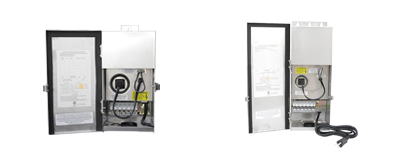
Radar Lighting’s RTR-50W/100W/150W-SS series lists a toroidal core and 12V, 13V, 14V, and 15V taps. Confirm the selected model’s installation requirements before specifying it.
Many electronic transformers originally intended for low-voltage halogen lamps use switching electronics and a smaller high-frequency transformer.
They can be lighter and more compact than comparable line-frequency units. However, their high-frequency output may not suit every LED replacement lamp.
Some require a minimum load or restrict the length of secondary leads. Both requirements are model-specific.
A lamp marked “12V AC” should not automatically be assumed compatible with every high-frequency electronic transformer.
The term “electronic transformer” is sometimes used loosely for an LED power supply. This can hide important differences.
A constant-voltage LED supply may provide regulated DC. A constant-current driver regulates current for a compatible LED module. Neither should be substituted for a landscape AC transformer without checking the load requirements.
Always identify:
Required output voltage.
AC or DC output.
Output current or power limits.
Constant-voltage or constant-current operation.
Supported lamp or fixture types.
For replaceable lamps, check the lamp specification as well as the fixture rating.
Selection factor | Magnetic transformer | Electronic transformer or LED supply |
|---|---|---|
Conversion method | Line-frequency magnetic induction | Switching conversion; design varies |
Typical physical format | Often larger and heavier | Often more compact |
Output | Commonly low-frequency AC | May be high-frequency AC or regulated DC |
Minimum load | Check the complete product and controls | Some require a minimum; LED-specific designs may differ |
Voltage taps | Available on some landscape models | Confirm available output adjustment |
Secondary cable limits | Calculate losses and follow instructions | Check losses and any stated lead-length restrictions |
Dimming | Requires approved transformer, control, and lamp combination | Requires the specified control method and compatible load |
Outdoor suitability | Depends on enclosure and product rating | Depends on enclosure and product rating |
Noise and service life | Product- and installation-dependent | Product- and installation-dependent |
The category name provides a starting point. It does not establish a guaranteed lifespan, pressure-free installation, or universal compatibility.
Replacing halogen lamps with LEDs can substantially reduce the connected load.
A traditional electronic transformer may fail to start reliably if the new load falls outside its supported range. Symptoms can include flashing, unstable operation, or no light.
However, there is no universal minimum of 20–30% for all electronic products. Use the stated range and, where available, the lamp manufacturer’s compatibility list.
Magnetic products also need assessment. Their loaded output, controls, and lamp compatibility should be checked after a retrofit rather than assuming every combination will work.
For AC LED loads, use published input current or VA data where available. Power factor and waveform characteristics can affect transformer loading.
If input watts and power factor are known at the relevant condition:
Apparent power (VA) = input watts ÷ power factor
For example, a 5W input load operating at a power factor of 0.70 represents approximately 7.14VA.
This is an illustrative calculation. It does not replace product-specific loading limits, compatibility guidance, or restrictions on the number of lamps.
Follow the manufacturer’s requirements for maximum load, individual circuits, ambient temperature, and any necessary derating.
Both supply types need suitable cable selection and a planned load distribution.
For line-frequency landscape systems, calculate voltage drop using actual cable lengths, conductor resistance, and downstream current. Verify voltage at the connected lights under load.
For high-frequency electronic transformers, also check the manufacturer’s permitted secondary-lead arrangement and length. These restrictions may involve performance and electromagnetic compatibility as well as resistive loss.
Do not apply a universal 30-foot or 50-foot limit to every electronic supply. Equally, a magnetic transformer does not guarantee a successful 150-foot run.
Outdoor suitability comes from the product’s documented rating and installation instructions, rather than its conversion technology.
Check exposure to rain, irrigation spray, standing water, condensation, direct sunlight, and corrosive conditions.
A weather-resistant enclosure is not necessarily suitable for burial or immersion. A stainless-steel case alone does not establish the complete assembly’s ingress protection.
Follow mounting, ventilation, drainage, and temperature requirements. Neither transformer type should be placed inside an additional enclosure without checking its effect on heat dissipation.
Review the supplied overload, short-circuit, and thermal protection, together with any specified surge performance.
A magnetic transformer should not be treated as lightning protection. An electronic supply should not be assumed to contain a particular surge-protection arrangement.
Compare documented operating conditions, warranty terms, service access, and replacement availability. Avoid assigning fixed service-life ranges solely from the technology.
For a product comparison, request the current specification sheets from Radar Lighting’s landscape transformer range.
On/off scheduling and dimming are separate functions.
A compatible timer or photocell can switch a lighting system without making its lamps dimmable. Likewise, an app-controlled transformer may provide switching only.
Magnetic low-voltage dimmers are commonly associated with forward-phase control, while electronic low-voltage dimmers are commonly associated with reverse-phase control. These labels do not replace confirmation of the complete combination.
Use a dimmer only where the transformer and lamps or drivers explicitly support it. Check the approved model, loading range, wiring method, and dimming performance.
For each lamp or integrated fixture, record its model, input type, rated load, permitted voltage range, and dimming requirements.
Then map the cable routes and identify which lights will operate together.
A compact group close to its supply may have different requirements from a property with several long landscape runs. Select the power supply around those conditions.

Identify the current transformer, lamps, controls, and wiring arrangement.
Inspect for damaged cables, deteriorated connections, and unsuitable additions. Flickering does not automatically prove that the transformer technology is wrong.
If converting from halogen to LED, confirm the proposed lamp combination and reassess load, output voltage, and controls.
Do not add resistive loads simply to satisfy a minimum-load requirement unless the manufacturer provides an approved solution.
Operate the intended lighting load and verify performance using the manufacturer’s commissioning procedure.
Check source output, representative fixture inputs, startup, switching, and dimming where applicable.
A conventional meter may not accurately measure a high-frequency electronic output. Use the specified instrument or test method rather than accepting an uncertain reading.
Isolate power before altering wiring. Supply-side installation and testing should be handled by appropriately qualified personnel.
Provide the supplier with:
Destination supply voltage and frequency.
Fixture and lamp models.
Total load and number of lamps.
Cable routes and lengths.
Required output type.
Timer, photocell, dimming, or connected-control requirements.
Mounting location and environmental conditions.
Contact Radar Lighting with these details to discuss available transformer options and request compatibility information for your project.
They can be, provided the lamps or fixtures support the output and the complete combination meets loading and control requirements. Check documented compatibility and loaded voltage.
Possible causes include an unsupported minimum load, incompatible output waveform, or a dimmer mismatch. Connections and individual lamp faults should also be checked.
No. Traditional electronic halogen transformers commonly provide high-frequency AC. LED power supplies may provide constant-voltage DC or regulated current. Identify the exact output before selection.
A landscape-rated magnetic model with suitable taps can be practical, but the result still depends on cable, current, and fixture limits. Electronic products need assessment against their specific cable requirements.
Only when the complete product is suitable for the location and installed as instructed. An indoor supply does not become outdoor-rated simply because it is placed in an improvised box.