Views: 0 Author: Site Editor Publish Time: 2026-11-09 Origin: Site


Choose a 150W transformer when its documented loading limits accommodate the connected lighting, planned additions, and circuit requirements. Consider a 300W model when the calculated demand exceeds the smaller unit’s permitted capacity or a defined expansion plan justifies the additional capacity.
The 150W vs 300W landscape lighting transformer decision is primarily about available output capacity. A higher wattage rating does not automatically provide higher voltage, longer cable reach, quieter operation, or independent lighting zones.
Start with the fixture schedule, then check loading, cable layout, controls, and installation conditions.
Table of Contents

The power rating identifies the transformer’s capacity under its specified operating conditions. It does not mean the unit continuously delivers that amount of power regardless of the connected load.
A compatible 300W transformer does not force 300W into a smaller lighting installation. However, its output voltage and supported loading range must still suit the lamps or fixtures.
Likewise, 300W does not mean twice the voltage of 150W. Two models can have different capacities while offering the same voltage taps.
Review the complete product specification, including:
Total permitted loading.
Individual circuit and output limits.
Terminal current and conductor requirements.
Compatible lamp or driver types.
Ambient-temperature restrictions.
Any required loading allowance or derating.
A total load within the transformer’s headline rating can still exceed a particular circuit or terminal limit.
Do not assume the entire capacity can be placed on one cable run.
An 80% planning allowance can be useful where specified, but it is not a universal rule that reduces every 150W transformer to 120W and every 300W transformer to 240W.
Use the manufacturer’s loading instructions and applicable project requirements. Distinguish mandatory derating from an optional reserve for future additions.
If a design uses a chosen reserve, state that assumption clearly rather than presenting it as a product limit.
For AC LED systems, adding lamp watts alone may not fully describe transformer loading.
Use the fixture or lamp manufacturer’s published VA or input-current information where available. If input watts and power factor are known at the relevant operating condition:
Apparent power (VA) = input watts ÷ power factor
Power factor is not the same as conversion efficiency. It describes the relationship between real power and apparent power, including the effects of current waveform characteristics.
Do not assign an assumed power factor simply because a lamp uses LEDs or has a low purchase price.
The following example uses assumed VA values:
Lighting group | Quantity | Assumed VA per fixture | Group load |
|---|---|---|---|
Path lights | 10 | 5VA | 50VA |
Accent lights | 6 | 7VA | 42VA |
Step lights | 4 | 2VA | 8VA |
Current total | 20 | — | 100VA |
Planned additional accent lights | 4 | 7VA | 28VA |
Planned total | 24 | — | 128VA |
These figures illustrate the process. They are not Radar Lighting specifications.

A 150W model may be a candidate for this design if its documented LED loading, circuit limits, and required allowances support it. A 300W model may provide useful reserve, but the schedule alone does not make it mandatory.
Reserve capacity should reflect a credible expansion plan.
If another lighting phase has a defined fixture count and load, include it in the schedule. If expansion is uncertain, compare the cost and installation implications of a larger unit with adding a separate transformer later.
Extra transformer capacity does not reserve capacity in existing cable, connectors, or terminals. Those components also need review before expansion.
A 150W model can be appropriate for a modest lighting load that remains within the product’s documented limits.
Examples may include a defined front-yard installation, a patio lighting group, or a separate landscape zone. Property size alone is not a reliable guide: a large site with a small lighting load may need less capacity than a compact site with many high-output fixtures.
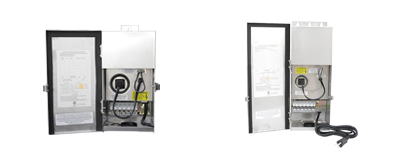
Radar Lighting’s RTR-50W/100W/150W-SS series lists multiple voltage taps and a stainless-steel enclosure. These features should not be assumed exclusive to larger models.
Confirm the selected 150W configuration and operating limits before ordering.
A 300W model becomes a practical candidate when the complete demand exceeds the smaller model’s permitted loading or when planned additions need more capacity.
It may also suit a project consolidating several calculated runs at one location, provided the terminals and circuits support the arrangement.
Radar Lighting’s RTR-300W/600W-SS series provides higher-capacity options. Request the circuit and terminal details for the specific unit offered.
Higher capacity does not automatically mean independently controlled zones. Confirm the control architecture separately.
A single 300W unit is not the only alternative to one 150W unit.
For widely separated lighting areas, separate appropriately sized transformers may shorten low-voltage cable routes or support different operating schedules. This depends on suitable supply locations, installation costs, and maintenance access.
Compare the complete installed system, including cable and controls. Keep outputs separate unless the manufacturer explicitly provides an approved interconnected arrangement.
Project condition | Selection direction |
|---|---|
Current and planned load fit the 150W model’s documented limits | Evaluate 150W first |
Demand exceeds the permitted loading of the 150W model | Evaluate 300W or another suitable configuration |
Long cable route with a small load | Calculate voltage drop; capacity alone does not decide |
Several areas need independent schedules | Confirm control zones or consider separate supplies |
Future additions are defined | Include their actual load and cable requirements |
Future additions are uncertain | Compare reserve capacity against installed cost and operating data |
Cable voltage drop depends on current, conductor resistance, route length, and load distribution.
A 300W transformer supplying the same current at the same loaded voltage through the same cable does not remove that cable’s voltage loss.
Possible improvements include lower-resistance cable, shorter routes, separate home runs, or an appropriate tap setting. A higher tap must keep every connected fixture within its permitted input range.
Do not select 300W solely because a cable exceeds 100 feet. Calculate the actual run.
Both Radar RTR product groups list 12V, 13V, 14V, and 15V taps, toroidal cores, and 304 stainless-steel cases.
This means the comparison should focus on the specific model’s capacity, circuits, terminals, dimensions, controls, and installation requirements.
Review the current landscape transformer range and request a configuration-specific quotation.
A stainless-steel case alone does not establish suitability for immersion, burial, or every corrosive environment. Follow the complete product’s outdoor installation requirements.
A larger rating does not mean the transformer always consumes its full rated power.
However, two transformers powering the same lights may have different core losses, winding losses, control consumption, and efficiency at that load.
It is therefore inaccurate to promise identical electricity costs. Compare manufacturer data or measured real input power under equivalent conditions.
VA is useful for assessing AC loading; electricity consumption is based on real power over time.
Commission the installation with the intended lamps operating. Check source output, fixture voltage, and circuit loading using the approved procedure.
Do not remove the lamp when the purpose is to measure the voltage it receives under operating load. Use a suitable test point or approved measurement arrangement.
Confirm control operation and record the final loads, tap assignments, cable routes, and readings. Isolate power before changing connections.
Contact Radar Lighting with the fixture schedule, planned additions, cable layout, destination supply, and control requirements to discuss a suitable transformer configuration.
Check the product’s loading instructions, lamp compatibility, VA or input-current requirements, and circuit limits. Do not approve the installation from lamp watts alone or apply an unsupported universal percentage.
No. Input consumption depends on the connected load, transformer losses, and controls. The rating describes capacity rather than constant energy use.
Divide the permitted design load by the actual per-fixture load for an initial estimate, then check circuits, terminals, compatibility, and cable performance. Different lamps can produce very different fixture counts.
Not necessarily. Long runs require voltage-drop analysis and compliance with the equipment’s cable limits. A larger capacity rating alone does not solve the problem.
No. Temperature and service life depend on construction, losses, loading, ventilation, ambient conditions, and installation. Compare documented performance rather than assuming it from wattage.