Views: 0 Author: Site Editor Publish Time: 2026-11-12 Origin: Site


A faint, steady hum can be normal in a magnetic landscape lighting transformer. A new, louder, rattling, or irregular sound deserves investigation, particularly when accompanied by flickering, protective trips, burning odors, or visible damage.
Landscape lighting transformer humming can involve the magnetic core, vibration transmitted through mounting surfaces, control incompatibility, or an electrical fault. Sound alone cannot identify the cause.
Start by recording when the noise occurs and what changed before it appeared. Then review the installation, connected load, and controls before deciding whether adjustment, service, or replacement is appropriate.
Table of Contents

A magnetic transformer’s core changes dimensions slightly as its magnetic field varies. This effect, called magnetostriction, contributes to operating hum.
A line-frequency transformer commonly produces a prominent component at twice the supply frequency: approximately 100Hz on a 50Hz supply or 120Hz on a 60Hz supply. Other vibration components may also be present.
The audible level depends on the transformer’s construction, mounting, enclosure, and surroundings. Some units are barely noticeable, while others can be heard nearby.
A steady sound that has remained unchanged may be consistent with normal operation. It does not replace checks of the equipment’s condition and operating limits.
A smooth low-frequency hum may originate from normal magnetic vibration. A rattle can involve an enclosure panel, mounting hardware, or another mechanically excited part.
Crackling, sizzling, or intermittent snapping should be treated differently from routine hum. These sounds can indicate a problem requiring prompt professional assessment.
Do not open the equipment or touch internal parts to locate the sound while it is energized.
Electronic power supplies often operate internally at higher frequencies, but that does not guarantee silent operation.
Magnetic components, capacitors, and operating modes can still produce audible tones or buzzing. Changes in load or control settings may affect the sound.
Replacing a magnetic transformer with an electronic product is therefore not a guaranteed noise solution. Output compatibility and outdoor suitability still need verification.
A transformer may sound louder because its mounting surface transmits or amplifies vibration.
A hollow wall, flexible panel, or lightly supported structure can make a modest vibration more noticeable inside a building. Nearby surfaces can also reflect sound.
Check whether the noise is strongest at the transformer itself or in the room or structure beside it. This distinction can help identify an installation issue.
Any mounting changes must preserve the manufacturer’s required support, clearances, ventilation, electrical connections, and environmental protection.
A loose serviceable cover or mounting point may respond to normal operating vibration.
With power disconnected, inspect only the accessible hardware identified in the instructions. Secure it using the specified method and tightening requirements.
Do not tighten internal core clamps, remove potting material, or modify internal supports. Excessive or unauthorized tightening can create new problems.
If the suspected source is inside a sealed assembly, request service guidance.
Noise that began after a dimmer change or LED retrofit deserves a compatibility review.
The transformer, dimmer, and lamps must form an approved combination. A lamp being dimmable does not establish that every upstream transformer or control is suitable.
Record whether the noise occurs at full output, only at low settings, or throughout the dimming range. This information helps the supplier assess the combination.
Do not assume that selecting a different dimmer setting permanently corrects an unsupported installation.

Review the total connected load, individual circuit limits, supply requirements, and installation temperature.
Overloading can increase heating and may operate protective devices. However, a louder hum does not by itself prove overload, and exceeding an arbitrary percentage does not establish magnetic saturation.
Use the transformer’s documented loading instructions. For AC LED systems, consider published VA or input-current information rather than adding lamp watts alone.
A larger transformer is not automatically quieter, and reducing load does not prove that an internal problem has been resolved.
Loose or damaged connections can cause localized heating, intermittent operation, or abnormal sound.
Voltage drop and poor connections should be investigated when fixtures also dim or flicker. However, cable resistance does not automatically cause the magnetic core to saturate.
A conventional transformer does not simply increase its effort to overcome every added resistance. The circuit response depends on the supply and load characteristics.
Inspect accessible wiring with power disconnected, and have heat-damaged terminals or other electrical damage professionally assessed.
Collect the following information:
Observation | Why it helps |
|---|---|
Noise present since installation or newly developed | Distinguishes the original baseline from a change |
Noise at startup or throughout operation | Helps identify operating-state dependence |
Noise changes with dimming | Supports a control-compatibility review |
Noise heard mainly through a wall | Suggests structure-borne amplification |
Noise follows added fixtures or replacement lamps | Identifies a change in load or compatibility |
Flickering, shutdown, odor, or visible damage | Indicates the need for further electrical assessment |
A short recording can help communicate the symptom. It is not a calibrated sound-level measurement or proof of a particular defect.
Confirm the model, supply voltage and frequency, connected fixtures, control devices, and mounting requirements.
Review whether the equipment has been covered, enclosed, obstructed by vegetation, or exposed to irrigation.
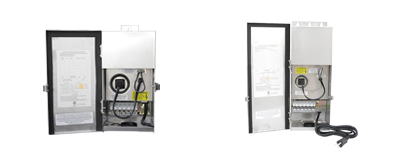
For product identification, Radar Lighting’s landscape transformer range provides a starting point. Use the exact model documentation for installation and service decisions.
The RTR-50W/100W/150W-SS series lists a toroidal core and multiple output taps. Those features alone do not establish a noise rating.
A qualified installer may compare operation with individual runs isolated where the manufacturer permits this procedure.
Power must be disconnected before conductors are removed or reconnected. Any required minimum load and test conditions must be maintained.
If noise changes when a branch is disconnected, investigate that branch, the total load, and control interaction. The result does not conclusively prove that the transformer is healthy.
Likewise, noise persisting without field wiring does not automatically prove separated core laminations. Mounting resonance, supply conditions, controls, and internal issues remain possible.
Where lights flicker, dim, or shut down, suitable electrical measurements may be needed alongside the noise assessment.
The person testing must identify the output type and use an appropriate instrument. A meter suitable for line-frequency AC may not accurately measure a high-frequency electronic output.
Do not change to a higher tap solely to reduce noise. Tap selection should follow fixture voltage requirements and loaded measurements.
Using a manufacturer-rated 15V tap correctly does not inherently overdrive a transformer core designed with that tap.
Where the equipment operates correctly and the installation amplifies vibration, a more suitable mounting location may help.
Use manufacturer-approved mounting or isolation arrangements. Do not insert improvised pads that compromise support, ventilation, bonding, or enclosure clearance.
Avoid wrapping the transformer in sound-absorbing material or placing it in an unapproved box. Noise treatment must not obstruct cooling or alter outdoor protection.
Use approved lamps, controls, and loading arrangements.
A compatible LED conversion may reduce load, but it should not be promised to eliminate hum. Recheck operating voltage and control behavior after changes.
Dividing lights among cable runs can improve distribution. It does not reduce total transformer load unless the connected demand is reduced or transferred to a separate approved supply.
Disconnect the equipment where it can be done safely if abnormal noise is accompanied by smoke, a burning odor, melted insulation, water inside electrical equipment, or repeated protective trips.
Do not repeatedly reset protection or bypass a protective device.
Warmth alone is not a reliable failure test, and touching the enclosure is not an appropriate temperature measurement. Compare measured conditions with the product’s limits through qualified assessment.
If service assessment identifies a failed or unsuitable unit, select a replacement using the fixture load, output requirements, controls, environment, and mounting location.
For noise-sensitive projects, ask for available acoustic information, including measurement conditions. Do not assume that “toroidal,” “electronic,” or “smart” guarantees quiet operation.
Contact Radar Lighting with the model, mounting photographs, fixture schedule, control details, and a description of when the noise occurs. Ask about available replacement specifications and installation guidance.
A faint, steady hum can be consistent with normal magnetic operation. Assess changes and accompanying symptoms. Sound alone cannot establish safety or failure.
The changed load or its interaction with the transformer and dimmer may affect operation. Check the approved combination, loading range, and output conditions.
Yes. A flexible or hollow mounting surface can transmit vibration into the building. Evaluate the mounting arrangement using the manufacturer’s guidance.
Not necessarily. Check actual loading and equipment limits. Normal core vibration, mounting resonance, or control interaction can also produce noise.
Not on that observation alone. An approved test must account for supply, controls, mounting, and load requirements. Request qualified assessment before condemning the unit.